What We Know (and Don’t) About Tornadoes and Climate Change
Illinois saw a record-smashing 212 twisters this year—was it a fluke or the new normal?

A tornado-damaged home in a residential neighborhood in Aroma Park, Illinois, March 2026
On an unseasonably warm, humid evening last March, a storm system moved through central Illinois. Lightning split the sky and warning sirens wailed as funnel clouds spun, their narrow tips drawing erratic lines of destruction across the land. Tornado after tornado tore through fields and towns, ripping up buildings, tossing debris, and snapping power poles.
Meteorologists tallied a total of 18 twisters churning their way through the state’s middle that night. Just five days later, 13 more touched down in Illinois during another major storm.
High-intensity, tornado-spawning weather systems continued to batter the Prairie State through the spring, summer, and even into the fall. At a whopping 212, more tornadoes hit Illinois this year than ever before—in fact, more than triple the previous record set in 2006.
“We didn't just break a record,” says Trent Ford, the state climatologist with the Prairie Research Institute at the University of Illinois Urbana-Champaign. “We completely smashed it.”
Illinois has long been a tornado hot spot, though maybe not recognized as such. People typically think of “Tornado Alley” as including Kansas, Nebraska, Oklahoma, and Texas, but twisters also tend to spin paths through Indiana, Kentucky, Mississippi, and southern stretches of Illinois. Even so, the twister frequency in Illinois this year was certainly unusual.
Only in the last two decades or so have meteorologists been able to accurately document tornadoes of any size.
Though it may be tempting to associate this year’s number of tornadoes with El Niño weather patterns, research suggests that this is unlikely. Overall, storms have been getting more severe due to climate change. Heat causes air to rise, and a warmer atmosphere holds more moisture, increases humidity, and can strengthen the jet stream, a ribbon of air in the upper atmosphere that undulates across the country. Research suggests that for each degree Celsius that the average temperature increases, the jet stream will get 2 percent faster. A faster jet stream could create more storms that spit out tornadoes.
Still, researchers caution that Illinois’s extra twisty season is not necessarily a sign of things to come.
“We can't really make any strong conclusions about what's happening from one year of data,” says Alan Black, an associate professor in the Geography and GIS department at Southern Illinois University Edwardsville. “Is this a permanent shift of Tornado Alley to the east? Or is it just that Illinois is having a bad year, tornado-wise?”
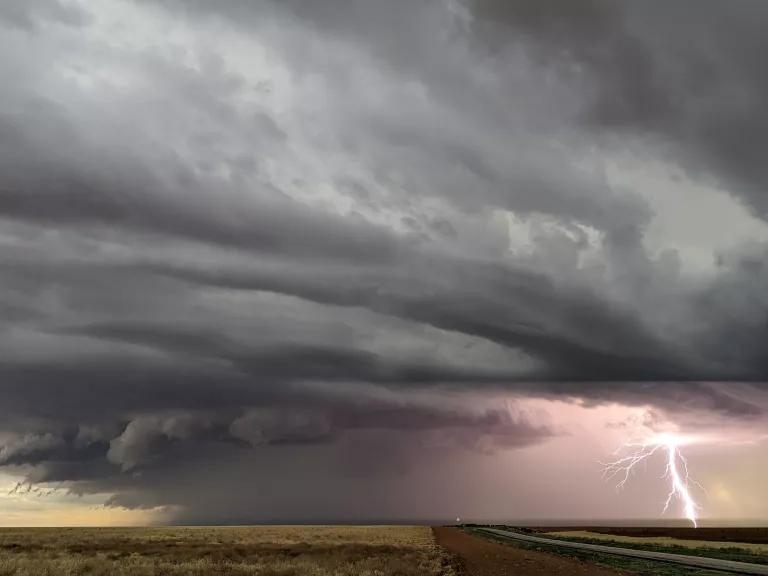
Lightning from a supercell storm cloud striking a field
More twisters or better technology?
Long-term trends in tornado frequency are difficult to decipher. Historically, local newspapers tended to document tornadoes with only a couple lines of text describing where the tornado hit, how many homes it damaged, and the number of people it killed. Left out, or unknown, were any details on wind speed or the distance the tornado traveled. Further, if a twister didn’t cause any damage or if no one witnessed it, the tornado likely didn’t make it into the public record at all.
Only in the last two decades or so have meteorologists been able to accurately document tornadoes of any size. Satellite data can now clearly show researchers where a twister, say, flattened corn and across what distance. This information is also included on publicly available maps.
“We're documenting more of these tornadoes than we were in the past,” says Evan Bentley, a warning coordination meteorologist at the National Oceanic and Atmospheric Administration’s Storm Prediction Center. (The center suffered cutbacks last year due to the gutting of federal agencies by the Trump administration’s Department of Government Efficiency, resulting in what some meteorologists say are less accurate severe weather forecasts.)
“[But] it's not necessarily true that that's indicative of a trend that's continuing,” he continues. Instead, it could just be that advances in technology are giving us a better picture of what’s happening in and around the sky nowadays.
That said, measuring changes in the intensity of tornadoes over time is still tricky. How a tornado rates on the Enhanced Fujita (EF) Scale, which indicates its strength, depends on wind speed, but researchers aren’t able to measure that in every twister. In those cases, they rely on the damage the tornado causes. If a tornado tears a roof off a house or knocks down three walls of a structure, it might be an EF-2. But this doesn’t make for the most consistent measuring stick: In addition to storm-tracking equipment being more precise, we construct buildings quite differently than we did decades ago.
“It's comparing apples to oranges, and that's one of the biggest challenges that we have for trying to maintain consistency through time,” says Brantley.
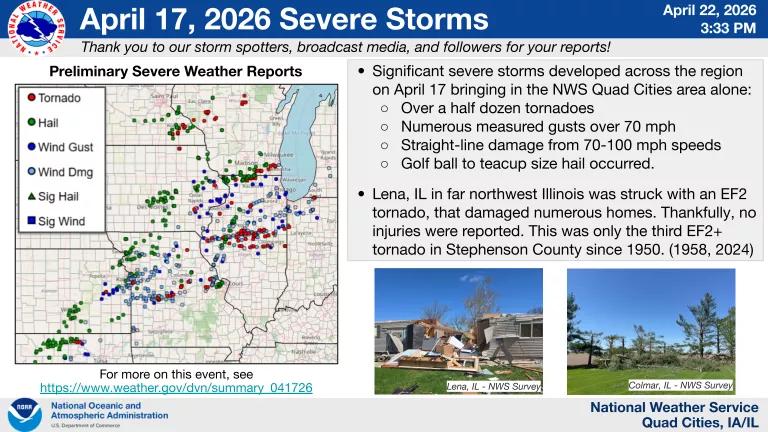
On April 17, 2026, using data from storm spotters, broadcast media and citizen reports, the National Weather Service recorded more than a half dozen tornadoes in the NWS Quad Cities area, including an EF2 tornado in Lena, Illinois.
A storm-chasing brigade
Another reason more tornadoes are making it into the public record today is because there are more people chasing storms, each with a camera in hand that can document or live stream the action. The National Weather Service even has a free storm spotter training program that’s open to the public. Such citizen science activity has helped researchers better assess where tornadoes occur and under what conditions.
“We are detecting tornadoes that maybe would not have been detected in the past,” says Black. “Now, there's probably somebody watching.”
And Black is helping to bring even more observers into the field. Every other summer, after two weeks of daily study and safety training, he takes two vans full of students and chases storms across the Great Plains.
“It's really nice, because I can show 1,000 pictures of a storm and talk about what's happening and show [the students] a bunch of videos, but it's a whole different thing if you can see it in person,” Black says. “This year, we would have probably just stayed in Illinois.”
Some of his pupils have gone on to chase storms themselves for fun. Others, like Emily Stanton, have pursued master’s degrees in geography and GIS, both necessary pieces of the meteorological puzzle of tornado impacts. When Stanton’s classmates decided to chase a storm in March, she was out of town, but they FaceTimed her so she could see what was going on.
“The shapes of the clouds and how they move…it's just methodical and weird,” she says. “It's really gorgeous to just watch.”
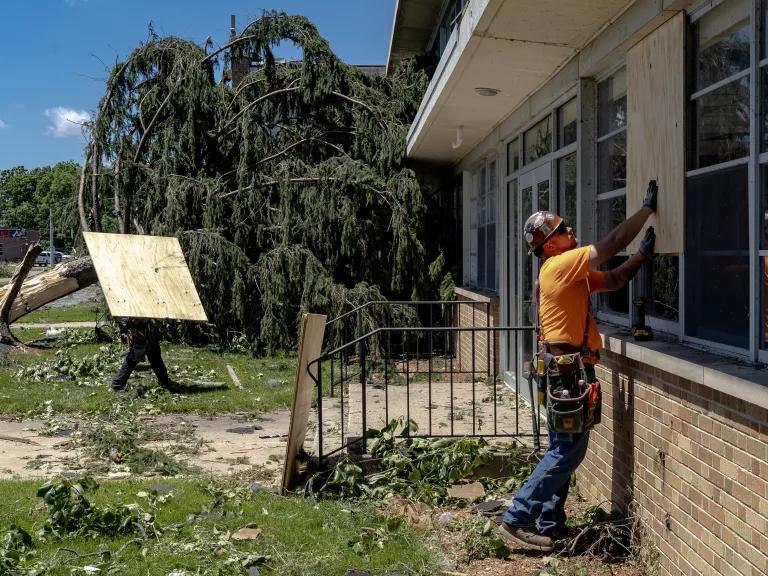
A cleanup crew boarding up broken windows at Andrean High School after it was damaged by tornado winds on June 12, 2026, in Merrillville, Indiana
The future of tornado research and recovery
One trend that researchers can confirm is that tornado season is getting longer, which could also be due to climate change. For many areas of the country, tornadoes start showing up in April with numbers typically peaking in May. But over the last decade or so, more twisters, like the ones that whirled through Illinois in March, have been emerging earlier in the year. This could be due to the higher moisture levels in the air along with the contrast in temperatures between the northern and southern parts of the country. A sharp differential here can accelerate the jet stream in the upper atmosphere and generate the wind shear needed to spur tornadoes. Whether that pattern results in more tornadoes, a longer season, or both is something climatologists and researchers continue to investigate.
They’re also looking into whether the regions in which tornadoes take shape and cause destruction are expanding or potentially shifting eastward. With weather balloons and drones, scientists take measurements underneath different types of storm systems, sometimes even sampling from just outside a tornado’s funnel, to answer where and why tornadoes abound in some storms but fail to form at all in others.
“We still don't understand the actual mechanism for tornado genesis,” says Bentley. “That's one of the foundational pieces that is really going to be needed to break through to that next-level jump in the scientific growth for tornado forecasting.”
No matter what happens from year to year, you don’t want to be caught off guard when a big storm comes to town along with a twister or two. With that in mind, communities could invest in battery storage to help keep the lights on when power lines go down and enhance sewer systems to be able to handle more flooding in shorter periods of time. Of course, such upgrades are pricey.
This is why the Illinois legislature proposed a bill last year that would make fossil fuel producers pay for the costs associated with climate adaptation projects. The legislation, which is also known as a polluters pay or climate superfund law, didn’t move forward, but its supporters are planning to reintroduce a similar bill again this year.
Building tornado-resilient structures could also go a long way toward protecting the public. Though some national building standards exist for structures in twister-prone locales, residential buildings, where two-thirds of the damage from tornadoes occurs, are not covered. Requirements for buildings where people work could also keep people safer.l After workers died in warehouses from tornadoes that ripped through Kentucky and Illinois five years ago, an Illinois task force recommended that warehouses have tornado shelters.
“The magnitude of observed change in tornado frequency here in Illinois is very small relative to the change in vulnerability that's come from development practices,” says Ford, commenting on how building standards haven’t kept pace with the threat of extreme conditions. “The biggest takeaway from this year is the importance of building resilience and preparing for severe weather before it happens.”
This NRDC.org story is available for online republication by news media outlets or nonprofits under these conditions: The writer(s) must be credited with a byline; you must note prominently that the story was originally published by NRDC.org and link to the original; the story cannot be edited (beyond simple things such as grammar); you can’t resell the story in any form or grant republishing rights to other outlets; you can’t republish our material wholesale or automatically—you need to select stories individually; you can’t republish the photos or graphics on our site without specific permission; you should drop us a note to let us know when you’ve used one of our stories.
Life on the Mississippi, Now
1.5 Degrees of Global Warming—Are We There Yet?
How EPA Rollbacks Will Cost Us—in Dollars and Lives