

The remains of a home destroyed by the Eaton Fire in Altadena, California, January 2025
Though the flames of Los Angeles’s monstrous January wildfires are long extinguished, the financial fallout is just beginning. With an estimated $53.8 billion in damages, rebuilding costs fall not only on the tens of thousands of people who lost their homes but also on the taxpayers funding disaster assistance programs.
This problem extends well beyond California. Homeowners and renters across the country are watching their insurance premiums skyrocket or their coverage get canceled. “Even if you live in the safest area of the United States, you’re not immune," says Alfonso Pating, a global financial regulation analyst with NRDC.
As climate disasters like the L.A. wildfires become more frequent, the home insurance safety net is fraying under the weight of rising costs. Who picks up the bill if the system collapses? All of us. Here’s why.
With rising climate risks come higher insurance bills
Home insurance exists to reimburse homeowners after losses from “perils”—events like fire or flood. When perils are rare, this system functions relatively smoothly. But as climate disasters grow more frequent and severe, the traditional insurance model struggles to cover so many claims that happen in the same place at the same time. The result? Insurers raise premiums, reduce coverage, write fewer new policies, or leave high-risk states altogether in order to stay afloat.
"So many things are wrapped up in [insurance failures]. From a housing angle, insurance premiums are one of the main drivers of inflation nowadays,” says Pating. In fact, premiums are outpacing inflation by a long shot. According to the National Bureau of Economic Research, between 2020 and 2023, average home insurance premiums increased by a third. Then, in 2023 alone, they went up an additional 11 percent. Once a relatively small expense in a homeowner’s budget, home insurance now accounts for 23 percent of the average mortgage payment.
The reasons behind these rate hikes are complex, but beyond the frequency of disasters and severe weather, factors such as inflation, supply chain, and labor issues have added to the costs of rebuilding and recovery. Now, insurers are raising premiums to make up for those losses and reflect the actual cost of climate risk.
Renters aren’t spared either. After the L.A. wildfires, the insurance company State Farm approached California state officials with a request to increase renters’ insurance premiums by 38 percent. Yet even if renters' premiums were to stay flat, rising insurance costs for landlords could drive up rents. Pating highlights another problem: When it comes to affordable housing, landlords can’t simply shift rising insurance costs onto renters, threatening the financial viability of new development.
Major insurers have also pulled out of states like Florida and Louisiana, where expensive climate disasters are common. There, homeowners have few options: move, pay more for less coverage, or go without—a practice known as “going bare.”

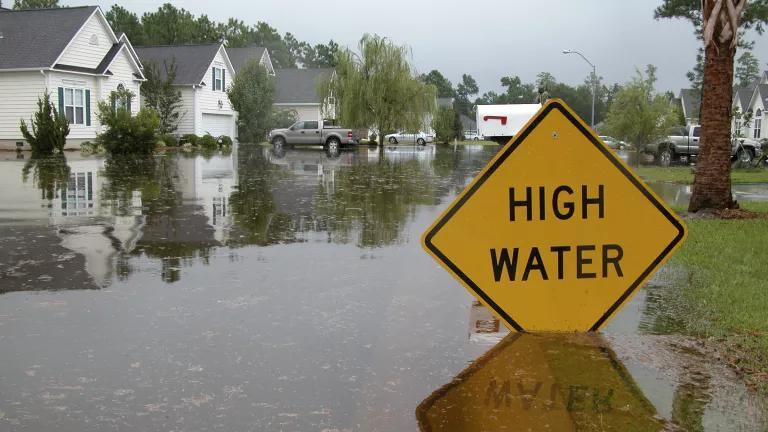
A home in Harris County, Texas, inundated by floodwaters after Hurricane Harvey
According to the nonprofit Consumer Federation for America, households with annual incomes of less than $50,000 are twice as likely to opt out of home insurance coverage, leaving them especially vulnerable if disaster strikes. Only 15 percent of homes in Harris County, Texas, for instance, had flood insurance policies when Hurricane Harvey hit in 2017.
The withdrawal of insurers from high-risk areas is a disaster in itself, since homeowners need coverage to protect their assets and stay compliant with mortgage lenders. But in a shifting climate, these pullbacks may also be a necessary warning, discouraging new development in places that are fast becoming unlivable.
Government-backed insurance programs, such as the National Flood Insurance Program (NFIP), have long subsidized development in risky areas like flood zones and barrier islands, a practice that NRDC has sought to curb through adoption of climate-informed floodplain development standards. But with private insurers pulling back, it forces a hard question: Should we stop developing in harm’s way and start encouraging relocation to safer areas?
A transition like this will be painful and costly, but rebuilding on lands where structures can last will almost certainly cost less than rebuilding in risky areas again and again.
NRDC’s director of insurance and financial risk, Alfonso Pating, breaks down how homeowner’s insurance works and why climate change is making it unaffordable.
When insurance fails, the public also pays
When private insurers withdraw, homeowners turn to state-run programs at a massive cost to taxpayers. Thirty-three states and the District of Columbia now operate “insurers of last resort” programs, such as Fair Access to Insurance Requirements (FAIR) plans. FAIR plans provide coverage to homeowners who are unable to secure private insurance. The plans, however, come with steep premiums and limited protections. And despite their high costs, their premiums don’t accurately reflect risk—so again, taxpayers cover the gap.
For example, the $1 billion recently requested by California’s FAIR Plan from the state’s insurers will most certainly be passed on to customers. Meanwhile, taxpayers directly fund state and federal disaster assistance and risk reduction programs through income, property, and sales taxes.
The NFIP, which insures flood-prone areas, has operated at a deficit since 2005 when Hurricane Katrina inundated New Orleans and surrounding areas. The program consistently underpriced premiums in relation to risk (which it also based on flood maps that are woefully out of date). As a result, the NFIP has relied on federal bailouts to stay operational, and as of February 2025, its debt totals $22.5 billion (even after a cancellation of $16 billion of debt in 2017).
"FEMA is borrowing $2 billion from the Treasury Department for the National Flood Insurance Program,” says Rob Moore, NRDC’s director of flooding solutions and environmental health. “They’re concerned they may not be able to pay claims going forward as we enter the next hurricane season."
Meanwhile, Project 2025, the radical policy blueprint laid out by the Heritage Foundation, a right-wing think tank, promotes replacing the national program with private insurance. This move could lead to prohibitively expensive premiums, more homeowners going without coverage, and even greater dependence on government disaster assistance.
Similarly to the NFIP, FEMA appears to be in the Trump administration’s crosshairs. “We’re going to eliminate FEMA,” said Homeland Security Secretary Kristi Noem at a cabinet meeting in late March. It remains unclear exactly why or how Trump would replace the current system.
Homeowners often turn to FEMA grants when private and public insurances fall short. After a disaster declaration, homeowners may receive small payouts from disaster recovery programs. However, research shows that the distribution of these payouts is uneven across socioeconomic and racial lines.

An abandoned home in the Lower Ninth Ward neighborhood of New Orleans, Louisiana, 10 years after the devastation of Hurricane Katrina
Black and other marginalized communities are less likely to receive federal assistance and receive less assistance when they do. FEMA payouts are also limited, often forcing families to choose between taking on predatory loans or living in unsafe conditions.
"Disasters destroy wealth and redistribute wealth,” says Moore. “Wealthier people often end up financially better off while poorer people get poorer."
This trend was perhaps most noticeable in New Orleans in the aftermath of Hurricane Katrina, when the predominantly Black community of the Ninth Ward experienced longer displacement times and a decline in wealth post-disaster. A 2018 study from Rice University and the University of Pittsburgh found that Black survivors of natural disasters lost an average of $27,000 in wealth, while some white survivors gained up to $126,000.
The options for those who can’t recover financially are grim: sell at a loss (often to wealthier investors who can afford to rebuild) or simply abandon their homes. In many areas, these vacant properties, or “zombie homes,” can contribute to urban decay, shrink local tax revenues, hurt small businesses, and erode the fabric of the community.
Learn More

Can FAIR Plans Help Build a More Resilient Future?
It’s Time to Fix Our Water-Logged National Flood Insurance Program

Choosing a Home with Climate Change in Mind
Growing climate risks, declining property values
For most homeowners, a house isn’t just a place to live—it’s their largest financial investment and a pillar of long-term wealth.
Not surprisingly, however, property values are beginning to reflect growing climate risks. For instance, in Florida, while home prices doubled between 2017 and 2024, that boom is over, with prices plateauing in recent months. Concurrently, some disaster-prone regions in the state experienced up to a 400 percent surge in home insurance premiums from 2019 to 2024, making homeownership significantly more expensive. As rising insurance costs strain affordability, fewer buyers are willing to—or capable of—purchasing homes. This has led to an increasing inventory of unwanted housing stock.
In response, migration patterns are shifting. Take Miami, where climate gentrification is on the rise. Here, longtime residents of neighborhoods like Little Haiti are being priced out as wealthier buyers seek homes in inland areas with higher elevations. Nationwide, climate disasters displace two to three million people annually, and, according to census data, many are permanently relocating to safer areas.
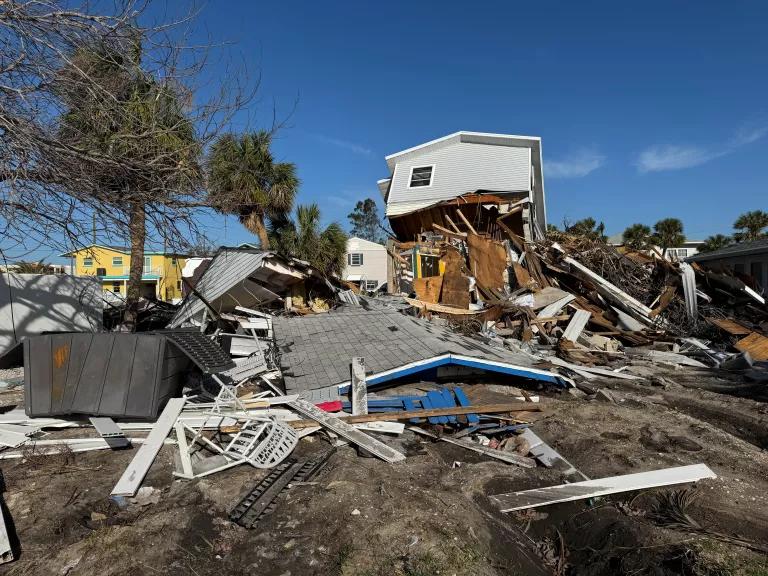
Homes destroyed and damaged by Hurricane Milton in St. Petersburg, Florida, October 2024
The First Street Foundation projects that rising insurance costs and increased climate risks could erode property values by $1.5 trillion in the coming decades, potentially prompting more than 55 million Americans to relocate to less vulnerable areas by 2055. People moving out of harm’s way would be a good thing, but such a rapid trend would profoundly change regional economies and strain local infrastructure and social services in newly popular areas.
As climate disasters mount, they’re destabilizing the insurance industry—with ripple effects across the economy. “This applies not only to housing but to infrastructure, transportation, agriculture, and industry,” Günther Thallinger, a board member of Allianz SE, one of the world’s largest insurance companies, recently warned in a LinkedIn post. “The economic value of entire regions—coastal, arid, wildfire-prone—will begin to vanish from financial ledgers. Markets will reprice, rapidly and brutally. This is what a climate-driven market failure looks like.”
Insurer pullbacks in high-risk states can trigger mortgage defaults, depress property values, and leave millions exposed, from retirees with insurance stocks to the nearly half of U.S. households invested in real estate–linked securities.
Meanwhile, homeowners in disaster-prone areas are trapped in a lose-lose situation. They can sell if they can find a buyer or rebuild if they can afford it, but then struggle to get affordable insurance coverage or live in unsafe conditions. One thing is clear: the longer they stay, the greater their vulnerability to future disaster.
Taking action: What you can do
We all pay for climate disasters, but we’re not helpless when it comes to cutting costs. If you own a home in a high-risk area, keep your insurance up-to-date and review it for gaps.
Beyond that, there are efforts we can all take to make ourselves more resilient to the threats in our areas. “We need to imagine a future where every home is not only a shelter but gives us real protection from extreme weather events—from hurricanes and floods to wildfires and heat waves,” Moore says. That may mean making upgrades like fire-resistant roofing (and landscaping), putting in storm-proof windows, and taking flood prevention measures in and around your property. All of these steps can lower risks, reduce repair costs, and decrease premiums if insurers offer discounts.
If you’re relocating or buying a home, keep climate change in mind and do your research. Climate risks don’t end at the property line—neighborhoods, cities, and regions matter too. Areas prone to floods, fires, or hurricanes carry long-term financial risk. Truly safe havens are rare, but knowing your risks can help you prepare.
To create large-scale change, we must advocate for policies that tackle the insurance crisis and support climate-resilient communities. The United States has made some recent progress on this front: The 2021 Bipartisan Infrastructure Law included $47 billion to help communities adapt to the climate crisis. Pushing for further investments in infrastructure—like stronger building codes, modern drainage, and community firebreaks—will help us reduce both disaster damage and long-term costs.
Stronger public-private partnerships can help stabilize the market by addressing the world as it is—not as we wish it were. By advocating for smarter, more equitable policies that address risk and resilience, we can build a more stable insurance system—one that protects people and communities while adapting to the realities of a warming world.
This NRDC.org story is available for online republication by news media outlets or nonprofits under these conditions: The writer(s) must be credited with a byline; you must note prominently that the story was originally published by NRDC.org and link to the original; the story cannot be edited (beyond simple things such as grammar); you can’t resell the story in any form or grant republishing rights to other outlets; you can’t republish our material wholesale or automatically—you need to select stories individually; you can’t republish the photos or graphics on our site without specific permission; you should drop us a note to let us know when you’ve used one of our stories.
How EPA Rollbacks Will Cost Us—in Dollars and Lives
How Hot Is Too Hot?
How to Stay Safe From Wildfire Smoke