Data Centers’ Power Grab Threatens U.S. Climate Progress
The rush to build on-site gas is a costly shortcut—and lawmakers and regulators must step in to stop it.

A child holds their notes, while preparing to speak against a proposed natural gas power plant that would be used to power a data center already under construction, during a public meeting hosted by the Ohio Power Siting Board at Teays Valley High School in Ashville, Ohio, August 19, 2026.
Why are some of the largest tech companies in the United States many of which have publicly committed to fully decarbonizing their energy supply—planning to build massive on-site fossil fuel generators to power their data centers? The way that the industry is planning to meet its need for speed threatens to set back U.S. climate progress, generate harmful air pollution, and hurt surrounding communities for decades. It doesn’t have to be this way.
The United States is experiencing an unprecedented build-out of large-scale data centers that often each consume the same amount of energy as an entire city. By 2030, data centers could consume as much as 649 terawatt-hours (TWh) a year, representing more than a tenth of all electricity consumed in the country. Yet growth of this magnitude hinges on the ability to rapidly increase energy supply at a speed and scale that the United States hasn’t accomplished in more than 50 years, and grid interconnection processes (which have been slow and arduous, long before the data center boom) now face backlogs of five to seven years in some regions.
The AI industry is highly competitive and incredibly well financed, and it values the speed of building new data centers above all else. As a result, many data centers are speeding up their energization by supplying their own power with new fossil fuel resources on-site, independent of the grid, aka, behind the meter (BTM).
Data centers with BTM generation still often connect to the grid for supplemental power supply to maintain 24/7/365 power supply rather than being “islanded,” which means being totally powered without a grid connection (though there are an increasing number of proposals for islanded data centers).
Even so, BTM gas generation is more polluting than supplying a data center 100 percent from the grid, even when much of the grid electricity comes from gas-powered plants. (This is because more conventional grid-connected combined cycle gas plants are less polluting, more efficient, and better regulated than many of the fossil assets being pursued in BTM constructs, such as reciprocating internal combustion engines, repurposed jet engines, etc.).
The scale of the potential build-out is alarming. The number of BTM gas projects in the United States doubled in the first half of 2026 alone, with experts tracking anywhere from 90 gigawatts (GW) to 177 GW of proposed BTM gas projects. This could generate the same amount of electricity that 68 million to 133 million average households consume in a year (assuming the new generators operate at 90 percent of their full capacity).
Learn More

Most alarming are the emissions outcomes. The emissions profile of the U.S. data center industry already dwarfs that of entire countries, and without immediate intervention, it will rapidly increase. A recent report from Bloomberg New Energy Finance estimates that if all proposed BTM gas plants at data centers are built, U.S. power sector emissions will increase by 10 percent.
But it doesn’t have to be this way.
Some developers have demonstrated how to build out data centers with quickly deployable energy solutions that maximize zero carbon power supply and minimize reliance on fossil fuels. For example, new investments in grid resources that aren’t necessarily BTM—e.g., virtual power plants, renewables paired with batteries, grid-enhancing technologies, and demand flexibility—have proven to meet immediate power needs.
It’s a false choice between clean energy and speed to power, which is precisely why we need strong guardrails that push the industry away from locking in dirty and expensive gas resources, and toward clean resources that don’t compromise our health and climate.
How data centers are powered will define whether the United States continues to make progress on decarbonization or whether we backslide on climate progress by decades. Central to this outcome is the degree to which proposed BTM gas projects are built, downsized, or canceled.
Why are developers turning to BTM power supply?
Typical utility interconnections for data centers require extensive studies, planning, materials procurement, and construction of infrastructure that can take years to complete under normal circumstances. The current tidal wave of data center development only extends these timelines on state, regional, and national scales.
And for an industry that values speed and competition above all else, data centers are willing to pay however much it takes to get connected. If the grid cannot supply energy fast enough, that means building their own energy supply BTM.
Fossil fuels are considered the easiest option, given the Trump administration’s repressive anti–clean energy policies and massive rollbacks on environmental regulations. The U.S. Environmental Protection Agency (EPA) has attempted to repeal and weaken bedrock environmental regulations and even exempt off-grid data centers from certain requirements. These federal backstops matter, especially in states and localities that rely on these rules as baseline protections, because such changes make gas generators easier to build and harder to regulate and litigate while creating existential risks to our air, water, and health. And turbine manufacturers and fossil fuel suppliers are seeing record-breaking profits amid this favorable policy environment.
If anything, these vested interests show that the corporate imperatives justifying BTM project development deserve even greater scrutiny.
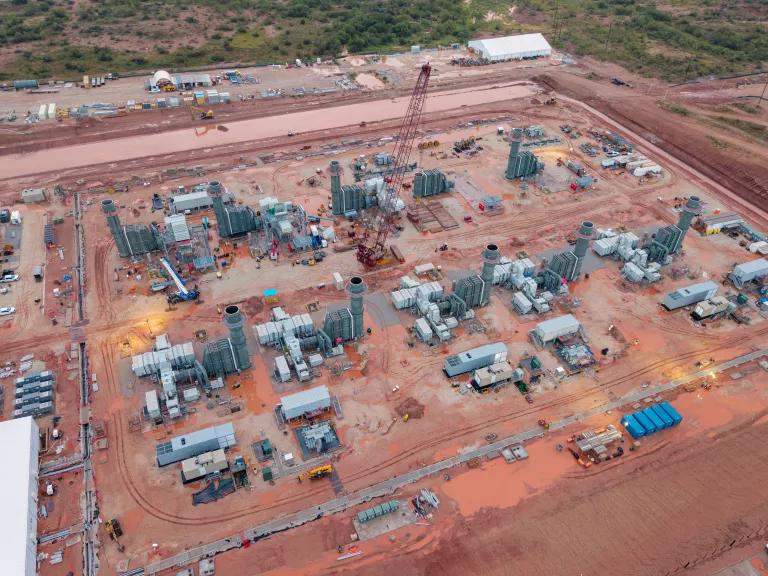
Construction of on-site gas turbines at the Stargate AI data center in Abilene, Texas, September 24, 2025
Why BTM gas is a bad idea
Proponents of BTM gas projects sometimes claim that they will act as temporary, bridging solutions until utilities are ready to connect a data center to the grid. However, a McKinsey & Company survey of data center developers found that 60 percent of respondents expected to have permanent on-site gas resources, even after a grid connection was made available. This dispels the notion that all BTM gas resources are a temporary, bridging solution and affirms that, to a significant degree, they will be here to stay.
Developers are viewing the BTM self-supply strategy as a determinant of competitive advantage and speed to power. This is a weak claim.
Surging demand for the most efficient large methane gas turbines is pushing new order deliveries to at least 2031. Plus, large gas turbines have stringent permitting requirements and often must face public scrutiny.
In a true race-to-the-bottom fashion, many developers are instead turning to smaller jet engines, reciprocating engines, and refurbished turbines to expedite operations. These resources are much less efficient and much more polluting than larger gas turbine alternatives and are subject to a patchwork of regulations that are grossly insufficient to protect communities.
Even with a weak regulatory environment, data centers have sought to further exploit loopholes, including by strapping engines to the back of trucks to meet “mobile” source requirements and by splitting the whole of their BTM resources into multiple, smaller projects when applying for permits.
Others have allegedly ignored regulatory requirements entirely. Operating illegally may expedite data center operations, but it is not a viable or commendable power supply strategy. Also, it’s illegal.
Not to mention, projects equipping smaller, less efficient engines are highly speculative and likely to be delayed. Many proposed projects have not yet received permits, and a large share don’t have a secured supplier. Broadly, construction progress is stalling due to local opposition, material shortages, and labor constraints.
Off-grid data centers will still cost us
There is also a risk that as more data centers connect to the grid and participate in wholesale energy markets, they will significantly drive up costs for all electricity consumers. A recent study from MIT found that from 2010 to 2024, data centers connecting to the grid have driven up average retail electricity prices by 2.7 percent. For investor-owned utilities, which serve approximately two-thirds of Americans, average retail prices rose 5.6 percent over the same period.
The risk to energy affordability is often used as justification to remove data centers from the grid entirely, thereby avoiding expensive, utility investments in infrastructure that may shift costs to other customers—and this is true, to an extent, from a utility’s perspective. Data center investments in new generation resources, whether BTM or grid connected, can help relieve skyrocketing energy and capacity prices. That said, we already have tools to assign data centers their fair share of costs, and these tools are being widely adopted across the country and rapidly improving.
And regardless of these benefits, we will still be paying the price for this build-out. Due to the basic fundamentals of supply and demand, increased demand for natural gas from data centers will raise gas prices by 5.8–15.9 percent nationally by 2030, according to a study from Evolved Energy Research, which found that customers could pay an additional $14.4 billion by 2030 as a result.
We will also be paying the price for these emissions from both a climate and a public health perspective.
For instance, Amazon is planning a 7.65 GW off-grid data center in Pecos, Texas, and has proposed to build 35 on-site gas turbines to power it. The facility has received state approvals to emit 33 million tons of carbon dioxide into the atmosphere, which would make it the single-largest source of CO2 emissions in the United States. Another permit was issued to Elon Musk’s proposed $24 billion data center project in Rio Grande Valley, Texas, for 35 natural gas turbines, producing 750 megawatts of power.
And an analysis commissioned by NRDC found that a proposed 9 GW data center in Utah called Stratos could emit 3,140 tons of fine particulate matter (PM2.5) a year, which would travel to nearby states—including Colorado, Idaho, and Wyoming—causing 45 additional premature deaths and $690 million in health damages each year.
More responsibility is shifting to state and local governments
As federal environmental backstops are weakened and removed, it is more important than ever to preserve and augment the authority of states and local governments to assess, review, and even deny BTM gas projects.
Critical to these efforts is giving communities a meaningful voice. As recent midterm election results have made overwhelmingly clear, community agency must be made more robust and determinative than corporate power and private capital—especially when it comes to our climate, our health, and our economic futures.
For proposed BTM projects still early in the development process, poor outcomes are not predetermined. Decisions on permitting, siting, and grid planning are being made today. The stakes are high and immediate. Ultimately, federal action is critically necessary, especially to improve permitting and siting processes for transmission and clean energy. But a large responsibility is falling to states and localities to take action now before it’s too late.
States and localities should:
- Remove any automatic approvals and fast-tracked approval processes to ensure projects are thoroughly reviewed in advance of construction;
- Close regulatory loopholes that allow off-grid or BTM projects to bypass standard utility commission oversight, environmental reviews, and any clean energy statutory requirements;
- Eliminate by-right zoning for data centers and the BTM gas projects to serve them in state law and/or local ordinances;
- Pre-emptively establish data center standards and local ordinances that require disclosure of BTM build-out, setback requirements, and limits on a facility’s usage, emissions (including greenhouse gas emissions, particulate matter, and nitrogen oxides), and noise;
- Require community engagement in zoning and siting approvals;
- Require cumulative impact assessments for data centers;
Ultimately, federal action by Congress and/or the EPA will be essential to mitigating this rush to BTM gas for data centers.
Local, state, and federal decision-makers are currently facing a critical inflection point regarding what the data center build-out will look like in the coming years. In addition to essential guardrails ensuring we maximize clean power/minimize fossil power, maintain grid reliability, protect consumers from footing the bill, protect water and other natural resources, and provide transparency for communities, it will be increasingly important for policies to directly address BTM resources to prevent digging a climate hole we’ll never be able to climb out of.
Some decision-makers are already leading the way, including with the POWER Act proposed in Illinois and with executive actions from Governors Abigail Spanberger in Virginia, JB Pritzker in Illinois, and Josh Shapiro in Pennsylvania.
This NRDC.org blog is available for online republication by news media outlets or nonprofits under these conditions: The writer(s) must be credited with a byline; you must note prominently that the blog was originally published by NRDC.org and link to the original; the blog cannot be edited (beyond simple things such as grammar); you can’t resell the blog in any form or grant republishing rights to other outlets; you can’t republish our material wholesale or automatically—you need to select blogs individually; you can’t republish the photos or graphics on our site without specific permission; you should drop us a note to let us know when you’ve used one of our blogs.
Related Blogs
Uncovering the Secret Documents Behind the Trump Administration's Clean Manufacturing Cancellations

We Can't Afford to Slow Down on Climate Action
