
Bridging the Heat Divide: Global Forum Advances South-South Dialogue to Spark Action
NRDC’s second-annual Global Heat & Cooling Forum (GHCF), held in New Delhi on April 20–21, 2026, convened global experts to shape an agenda for keeping people cooler as global temperatures rise.


Updated August 3, 2026
As global temperatures continue to climb, extreme heat is no longer a distant threat—it is a present-day crisis that increasingly threatens human health, erodes labor productivity, and undermines progress toward critical development goals. But while the whole planet is warming, heat impacts are experienced unevenly, especially across the Global South.
In the Global South, extreme heat is exposing a deeper truth: a widening divide in preparedness. This gap isn’t just about discomfort and inconvenience; it’s a fundamental and growing disparity in climate adaptation that leaves the most vulnerable—low-income communities, the elderly, and outdoor workers—at increasing risk of health and economic harm. Closing this gap will require moving beyond reactive responses toward integrated strategies that strengthen heat resilience while expanding access to affordable, climate-friendly cooling.
Against this backdrop, GHCF 2026 brought together policymakers, researchers, practitioners, industry leaders, and civil society voices to exchange lessons, build partnerships, and advance implementation.
Living in extreme heat is more than just a physical discomfort—it can impact your livelihood and overall health and well-being. NRDC’s director of cooling and climate resilience, Prima Madan, talks about how India is adapting to rising temperatures and what the rest of the world can learn from them.
Renewed focus on implementation
When NRDC launched the inaugural GHCF in 2025, our goal was to ignite a coordinated international platform that could unify the dialogue around heat preparedness and cooling access. Last year’s forum succeeded in bringing together a powerhouse of regional policymakers, researchers, and civil society leaders to underscore how integrated solutions can secure and sustain longer-term resilience, with a focus on the Indian context and pathways for policy strengthening.
This year’s event marked a pivotal shift. We moved beyond the “what” and the “why” of heat risks and cooling technology gaps to dive deeper into the “how.” This year’s GHCF was laser-focused on dialogues that will advance on-the-ground implementation. We weren’t just talking about ideas; we were surfacing breakthrough implementation pathways that can be scaled across cities and nations. India’s National Disaster Management Authority, the Department of Science & Technology, and the global Coalition for Disaster Resilient Infrastructure (CDRI) co-organized the forum this year with us.

An initiative first envisioned in the 2025 forum came to fruition in 2026 with the launch of the Center of Excellence for Heat Resilience and Sustainable Cooling. Established through a partnership between NRDC and the government of Maharashtra, the center will serve as a platform to strengthen research, build capacity, and support implementation for scalable heat resilience and sustainable cooling solutions. GHCF 2026 also hosted the launch of the Global Heat Health Information Network South Asia Hub, which will strengthen regional collaboration, evidence generation, and knowledge sharing to support heat health action across South Asia.
Deep conversations on solutions that scale
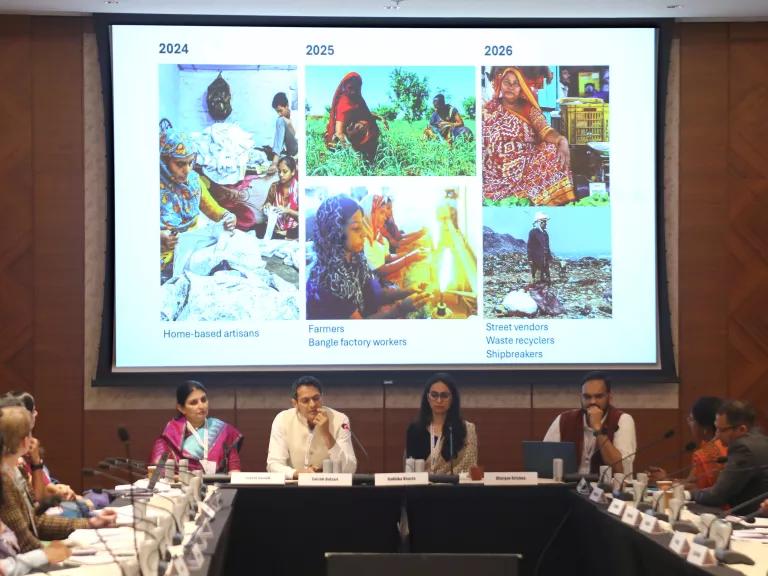
Building on the foundation laid last year, the GHCF 2026 agenda featured six thematic sessions spanning occupational health, adaptation governance, infrastructure, building regulations, community‑ and equity‑centered approaches, and South-South collaboration, particularly India and Africa.
Each session was co-curated with expert anchor partners: the Sustainable Solutions for Africa (SSA), SouthSouthNorth (SSN), the Global Heat Health Information Network, Sustainable Energy for All (SEforALL), Harvard University, Nand & Jeet Khemka Foundation, University of Oxford, Ashok B Lall, Alliance for an Energy Efficient Economy, Council on Energy, Environment and Water, Prayas (Energy Group), and Climate Trends.
Across the forum, discussions converged on a common set of priorities for scaling solutions. Stronger governance, cross-sector coordination, and sustained financing are needed to shift from reactive heat responses to long-term resilience. Integrating health, labor, energy, and environmental data, while strengthening local capacity, will also be critical to translating evidence into effective policies and implementation.
South-South synergy: Sharing lessons from India and Africa
One of the most exciting pillars of GHCF 2026 was our expanded focus on South-South cooperation. Many of the technical and policy challenges faced by countries in South Asia and Africa share common themes, and there is immense power in cross-dialogue and knowledge sharing between these regions. A dedicated thematic session—delivered in partnership with SEforALL, SSN, and SSA—specifically examined heat preparedness and cooling solution intervention insights from Indian and African contexts. By fostering this multi-sectoral collaboration, GHCF 2026 highlighted locally led approaches and case studies that can resonate and scale across the Global South through new communities of practice.
Centering the unheard: Solutions rooted in lived experience
Narrowing the divide in heat preparedness requires a look beyond global temperature projections and health risk statistics and a focus that is deliberately on those on the frontlines of the climate crisis: informal and gig workers, women, and children. This year’s GHCF provided a platform to surface the unique perspectives of these heat-sensitive populations. We prioritized dialogues that center their voices, recognizing that a delivery rider navigating intense heat or a mother managing a household in an urban slum each has a story to tell that is too often invisible in science, the media, and policymaking. Our goal was to move from designing solutions for these communities to designing with them, ensuring that the next generation of heat-health interventions is built upon the lived realities, priorities, and resilience strategies of those who feel the heat most acutely.
Heat-resilient buildings and infrastructure
This year, we also explored the critical but sometimes overlooked dimension of infrastructure resilience. Extreme heat doesn’t just affect human biology; it threatens the physical systems that keep our society running. It poses a systemic risk to the reliability of our power grids and the safety of our buildings. In partnership with the CDRI, GHCF 2026 featured a new thematic session that will center on ways to ensure that the infrastructure of the future is built to withstand the climate of the future.
Moving global action forward
GHCF 2026 reinforced that the path forward is not only about identifying solutions but also ensuring that they are translated into action where they are needed most. Achieving this will require sustained collaboration, stronger institutions, and investment in approaches that can be adapted, replicated, and scaled across regions. By advancing coordinated and inclusive action on tested solutions, we can ensure that the most heat-vulnerable communities are protected by resilient infrastructure and equitable cooling solutions.
For more details, visit the GHCF website here.
Please find the detailed proceedings of the GHCF here.
This expert blog was originally published on April 6, 2026, and was updated on August 3, 2026, with new information and links.
This NRDC.org blog is available for online republication by news media outlets or nonprofits under these conditions: The writer(s) must be credited with a byline; you must note prominently that the blog was originally published by NRDC.org and link to the original; the blog cannot be edited (beyond simple things such as grammar); you can’t resell the blog in any form or grant republishing rights to other outlets; you can’t republish our material wholesale or automatically—you need to select blogs individually; you can’t republish the photos or graphics on our site without specific permission; you should drop us a note to let us know when you’ve used one of our blogs.
Related Blogs
Finance Beyond the COP: How India Is Rebuilding the Case for Global Climate Finance

New Regional Initiative Strives to Advance Heat Adaptation Across South Asia
