Adapting to a Changing Climate Is the Bedrock of a Stronger America
Climate change isn’t at our door—it’s knocking it down.

People stranded on the roof of a home amid floodwaters in New Orleans the day after Hurricane Katrina

This summer, as we marked the 20th anniversary of Hurricane Katrina, Americans once again watched in horror as catastrophic flooding engulfed central Texas. A father died saving his children as a wall of water rose around them. Parents lost their young twins. Families awoke to frantic voicemails from loved ones they would never hear from again.
When the waters finally receded, more than 135 people were dead—another entry in the growing list of climate-fueled disasters: wildfires in the West, hurricanes in the South, deadly heat waves across the Midwest, and many other climate disasters in our cities. Behind every number is a grieving family, a traumatized community, a life forever changed.
Two decades after Katrina claimed 1,300 lives, these once-rare catastrophes have become a fixture of American life. No matter where you live, what you look like, or how you vote, the climate crisis is now an immediate and deadly threat—and a rapidly growing cause of death in the United States. Yet our efforts to prepare for it lag far behind the danger. Communities remain exposed. Infrastructure keeps failing. Recovery is too slow and too uneven. Insurance rates are skyrocketing.
Adapting to stronger storms, deeper floods, and more dangerous heat is essential—not only to save lives and reduce costs but to build safer, healthier, and more prosperous communities that can thrive in a changing world. We can expect the pace and intensity of these extreme weather events to accelerate. At the current rate of warming, we may soon reach tipping points that speed up changes in the earth’s climate—like melting Arctic permafrost that releases methane and carbon dioxide, shrinking sea ice that reduces the planet’s ability to reflect heat, and the loss of the Amazon rainforest, which could turn from a vital carbon sink into a source of emissions. Together, these changes could set off a vicious cycle of more warming and more extreme weather. The case for adaptation is no longer theoretical; it’s a race against dangerous feedback loops that are making our world more volatile, more dangerous, and harder to live in.
Adaptation must be woven into every level of policy, planning, and investment. Climate change affects every sector of the economy and every facet of daily life—it can no longer be treated as an afterthought.
The alarm bells should be going off
It should alarm every American that the Trump administration is dismantling the nation’s disaster safety net just as extreme weather grows more frequent and more severe. In only a few months, it has gutted programs that protect people from floods, fires, and storms—leaving us weaker, more fragile, and less able to warn, protect, or recover when disaster strikes.
The National Oceanic and Atmospheric Administration (NOAA) and its National Weather Service—our early-warning systems—have suffered deep budget cuts, undermining our ability to forecast hurricanes, floods, and other extreme events. These are not abstract losses. They mean missed warnings, preventable deaths, and communities blindsided by disasters that could have been anticipated.
At the Federal Emergency Management Agency (FEMA), roughly a third of the staff has been lost through layoffs, furloughs, or forced resignations, including many of the experts best equipped to manage disasters effectively. The administration has revoked nearly $4 billion in FEMA grants meant to strengthen flood barriers, modernize evacuation systems, and reduce wildfire risks. It even eliminated the commonsense requirement that public buildings and infrastructure be rebuilt stronger after floods—a safeguard born from decades of painful lessons. Trump has said he ultimately wants to eliminate FEMA altogether, leaving states to fend for themselves without the coordination or funding they need.
These cuts hit hardest in low-income communities and communities of color, which already bear the brunt of extreme weather. They are compounded by a broader effort to erase equity from federal policy, stripping away protections for those most at risk. Through these actions, the government is abandoning one of its most basic duties: to safeguard its people. It is as if the lifeboats are being destroyed just as the iceberg scrapes the hull—a reckless act of denial that leaves millions in peril.
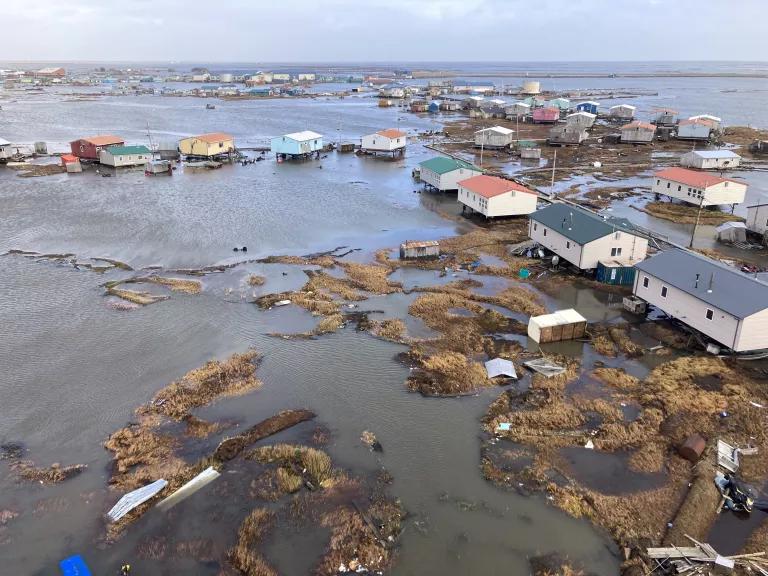
Search-and-rescue operations over Kipnuk, Alaska, following the devastating Typhoon Halong, October 2025
We can’t afford not to adapt to extreme weather
The climate crisis is no longer a distant threat; it’s reshaping our health, economy, and daily lives right now. Changing patterns of extreme weather plus increasing development and population in hazard-prone areas are a deadly combination. The scale of destruction and the cost of recovery are staggering.
In 2024 alone, the United States endured 27 separate billion-plus-dollar disasters, costing nearly 600 lives and tens of billions in damages. The year 2025 is already on pace to surpass that, with wildfires, floods, and heat waves pushing losses beyond $125 billion in just the first half of the year. Extreme heat, now the leading cause of weather-related deaths in the United States, has doubled its toll since 1999, straining hospitals and power grids, reducing productivity, and putting workers’ lives at risk.
While sudden disasters dominate headlines, slower-moving crises like sea level rise are steadily forcing communities to relocate and reshaping population patterns. Insurance markets are buckling under the strain. Homeowners’ premiums jumped more than 30 percent between 2020 and 2023, driven in no small part by climate risk. Families who can no longer afford coverage face foreclosure; for many others, the dream of homeownership—and a foothold in the middle class—is slipping away.
Every community feels these impacts, though not equally. Seniors, women, children, people with disabilities, and low-income communities of color are most vulnerable and have the fewest resources to recover. For them, cuts to disaster-relief and adaptation programs are not policy choices; they are existential threats.
Reducing climate-warming emissions remains essential. But even if emissions stopped tomorrow, the world we once knew would not return. Our infrastructure was built for a climate that no longer exists. We must adapt to the one we have. People everywhere are feeling the change: hotter summers, smokier skies, more destructive fires and hurricanes. As Alaska’s Senator Lisa Murkowski recently said after floods forced more than a thousand Alaska residents into emergency shelters, “Whether you call it climate change or ‘once-in-a-generation’ extreme weather, no community in the wealthiest country on earth should lack the basic infrastructure needed to keep its people safe.” Months earlier, the U.S. Environmental Protection Agency had canceled a $20 million grant meant to protect that very community from flooding.
Adaptation is not optional. It is both a moral imperative and an economic necessity. Every dollar invested in resilience yields up to $13 in benefits through avoided losses, lower recovery costs, and stronger local economies. Adaptation saves lives, protects homes and businesses, and strengthens the fabric of our communities. It’s not just about surviving climate change; it’s about building a nation that can prosper in spite of it.
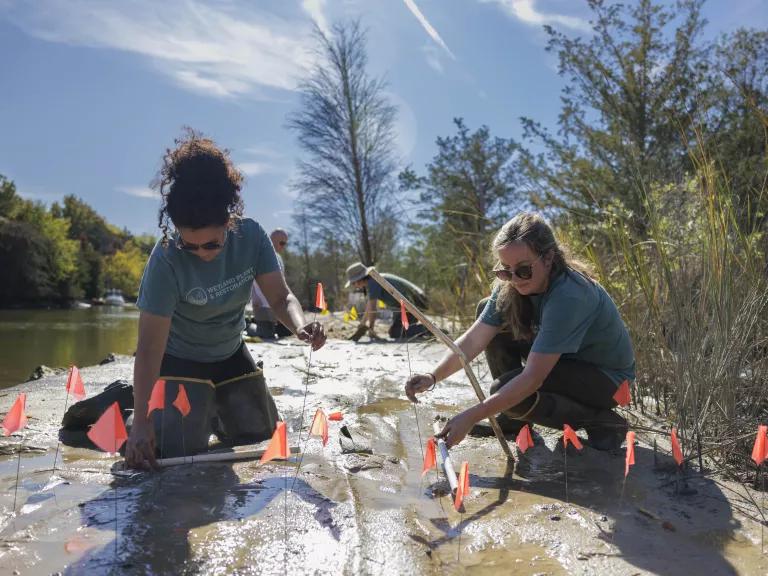
Researchers from Old Dominion University's Wetland Plant & Restoration Lab plant marsh grass along a channel at Whittaker Creek in Gloucester, Virginia, as part of a project to test the use of dredge materials in stabilizing shorelines.
NRDC’s vision for a national embrace of adaptation
Meeting this challenge requires a revolution in how we understand climate risk, how we plan for climate impacts, and how we pay for building resilience.
We need a clear-eyed reckoning with the risks we face—and a shared commitment to make those risks visible and actionable. That starts with better data: clear, consistent, and accessible to the people who need it most. This requires a reversal of the current trend, wherein the very agencies designed to provide that data—like the NOAA and its National Weather Service—are being hollowed out, leaving dangerous gaps in forecasting and risk information just as we need them most.
We must improve risk mapping, integrate local knowledge, and elevate the lived experience of frontline and Indigenous communities. Nature must also be understood as a fundamental form of resilience—a living system that buffers us from the worst impacts of climate change. Healthy wetlands absorb floodwaters, forests regulate rainfall and protect watersheds, and urban tree cover cools neighborhoods and saves lives. Nature-based solutions—like restoring wetlands and urban tree cover—must be treated as essential infrastructure, not optional add-ons.
Public and private institutions alike must integrate this understanding into every decision—about infrastructure, zoning, lending, and insurance—so that risk is priced and managed, not ignored until it becomes a catastrophe. We can harness the power of advanced computing and artificial intelligence to combine what satellites see from space with what people experience on the ground. By building on local data and embracing community science, we can close the information gap left by the federal pullback and create a detailed national picture of climate risk.
Adaptation must be woven into every level of policy, planning, and investment. Climate change affects every sector of the economy and every facet of daily life—it can no longer be treated as an afterthought.
Because impacts are inherently local, planning must start with the voices of those most affected. State and local governments need the authority and resources to lead—with full federal partnership and coordination. The private sector must strengthen its own resilience and be transparent about how it manages climate risk, given the far-reaching effects of its operations.
Nature’s resilience should also be a pillar of our planning—not only because healthy ecosystems protect people but because nature itself is worth defending.
Financing adaptation remains one of the greatest barriers to progress. Despite overwhelming evidence that every dollar invested in resilience yields up to $13 in benefits, many investors and resource-constrained governments hesitate—reflecting a familiar “present bias,” a tendency to discount long-term rewards for short-term gains.
We must do more to communicate the clear economic case for adaptation and to recognize leaders who invest in the long term. The public sector must lead through direct investment and smart incentives that mobilize private capital. For the private sector, adaptation should be recognized not only as risk management but as a driver of lasting value and competitiveness.
Adaptation must tackle the structural inequities that leave underserved communities most exposed and least protected. Climate change will only deepen divides.
True resilience means investing in the people and places most affected, giving them the tools and power to shape their own future. Equity is not only a moral imperative—it is the foundation of durable resilience. A nation that builds understanding, plans wisely, finances boldly, and prioritizes equity will protect not just lives but the very fabric of its society.
Climate disasters don’t respect borders any more than they distinguish between red or blue states. The United States must embrace adaptation as part of a global effort. When nations share knowledge, coordinate strategies, and innovate together, they unlock significant benefits for people worldwide.
Resilience abroad strengthens security at home: It reduces forced displacement, prevents humanitarian crises, and stabilizes fragile regions. The United States also has much to learn from developing countries whose residents have long lived on the frontlines of climate risk. We must listen to them. Their experience holds lessons for all of us about how to endure, adapt, and even thrive.
NRDC is elevating our commitment to adaptation
For decades, NRDC has helped build the laws and institutions that protect people from environmental harm: from clean water safeguards and disaster recovery standards to stronger housing, infrastructure, and public health policies. We have long argued that adaptation must be central to climate action, using science, policy, law, and the power of the people to make that case.
Now, as the climate crisis accelerates and federal leadership falters, NRDC is leaning in more strongly and creatively than ever before. We are doubling down on solutions that help people weather disasters, stay in their homes, and build safer, fairer, more resilient communities.
Here are four key areas where we are pushing forward—always in partnership with states, cities, advocates, and the communities on the frontlines.
Wildfires, floods, and storms are striking harder and more often, driving insurance markets toward collapse. NRDC is working to stabilize state-led systems so homes remain insurable and communities remain secure. We're partnering with states to expand investments in resilience, rewarding homeowners and communities that take action to reduce risk. Our goal: affordable, reliable insurance that protects people, not just property, and that helps families stay in their homes as the climate changes.
Extreme weather is hitting harder just as our national disaster safety net is being dismantled. NRDC is defending the essential role of the federal government in helping states and cities prepare for, respond to, and recover from disasters.
We work directly with state and local leaders to ensure recovery efforts reduce future risks rather than simply rebuilding them—and that underserved communities are centered in planning and rebuilding. Our goal: states and cities that are ready when disaster strikes, so damage to people and infrastructure is minimized and recovery is swift, equitable, and lasting.
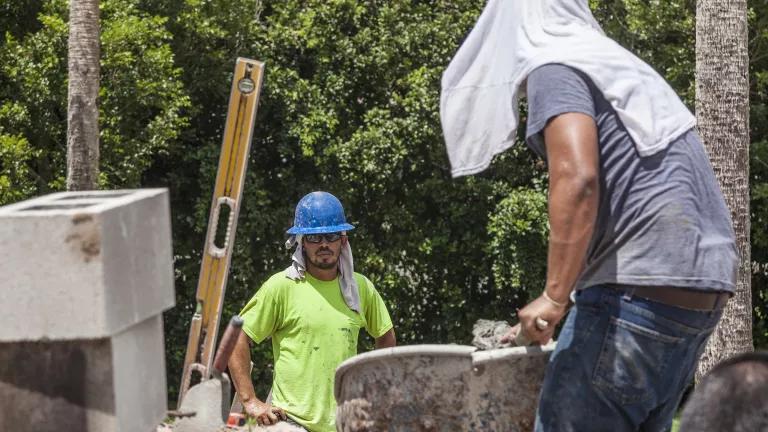
Record-breaking heat waves now threaten hundreds of millions of Americans, endangering public health, straining power grids, and devastating local economies. Yet in some states, including Texas and Florida, lawmakers have gone as far as to ban local protections requiring rest breaks for outdoor workers. It’s a shocking step backward that treats workers as expendable, not essential.
NRDC is fighting to restore and expand protections for those most at risk—especially workers, seniors, and low-income families. We’re advocating for national heat-safety standards, stronger public health systems, and urban cooling solutions that lower temperatures and save lives.
Our goal: when extreme heat strikes, workers have enforceable rights; households have access to affordable, efficient cooling; and our health systems are ready to respond.
Financing adaptation at the scale we need requires new thinking and new accountability. NRDC is working to translate the dollars-and-cents case for resilience, making it clear that protecting health, homes, and nature is among the smartest investments any government or business can make.
We’re advancing policies that hold polluters accountable and generate new, fair sources of resilience funding. This includes helping states ensure that oil and gas companies pay their fair share for the damage they’ve caused and pushing financial institutions to treat adaptation as a driver of long-term value, not an afterthought.
Our goal: adaptation funding that is stable, equitable, and sufficient to meet the scale of the crisis.
Together, these efforts reflect NRDC’s vision of a nation that meets the climate crisis not with denial or despair but with resolve—building resilience that protects every community, defends nature, strengthens our economy, and upholds our shared responsibility to one another.
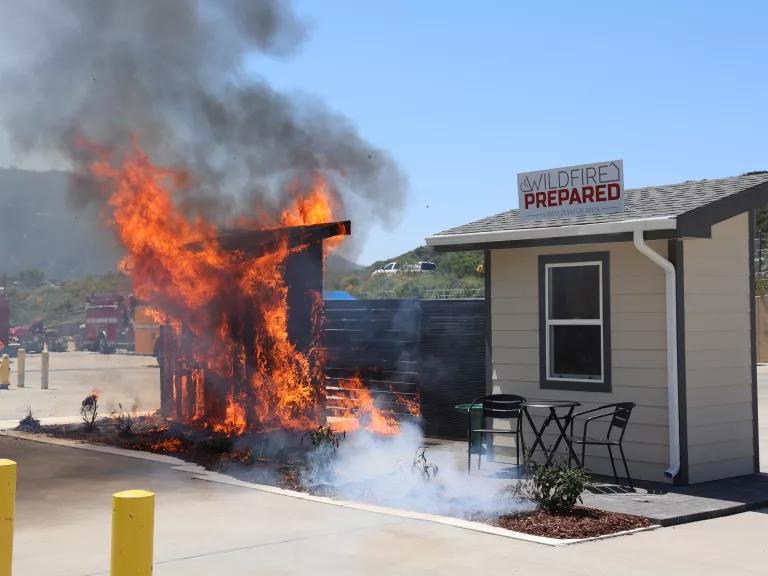
A side-by-side demonstration showing the effectiveness of research-based wildfire mitigation actions
Adaptation is key to building a vibrant and resilient economy
Adaptation cannot be treated as an isolated exercise or a checklist of projects to complete. It must be woven into everything we do: how we build our homes, design our cities, run our businesses, plan our budgets, and care for one another. Resilience should not sit on the margins of our national agenda; it should be the thread that connects everything.
When we treat adaptation as the foundation of progress rather than the price of failure, we open the door to something larger. Building resilience will not only avert disasters and prevent needless deaths; it will strengthen the very systems that make our society work. It will protect our health, our homes, and our livelihoods. It will stabilize markets, unlock innovation, and help communities thrive in every region, from coastal towns to rural heartlands.
We can never undo the pain felt by families like those who lost loved ones in the floods this summer: the father who gave his life to save his children, the parents who lost their twins, the countless families whose lives will never be the same. But we can honor them by learning from these tragedies and committing ourselves to do better—to build communities that are stronger, safer, and prepared for what’s ahead.
Resilience is about far more than weathering storms. It is about creating the conditions for lasting economic prosperity, security, and well-being. A resilient America is one that can withstand every kind of shock and crisis; not only those fueled by a warming planet. It is a country where people feel safer, businesses can plan with confidence, and opportunity is not washed away by the next flood or burned up in the next wildfire.
We must build a future where adaptation is recognized for what it truly is: the bedrock of a stronger, healthier, more secure America—and a lasting tribute to those whose lives remind us what is at stake.
Related Resources

The Insurance Affordability Crisis: Risks, Resilience, and Solutions
Occupational Heat Safety Standards in the United States