Governors Have an Opportunity to Lead on Reducing Household Transportation Costs
In California, Colorado, Georgia, and Michigan, reducing transportation costs is a key part of prioritizing affordability for families.
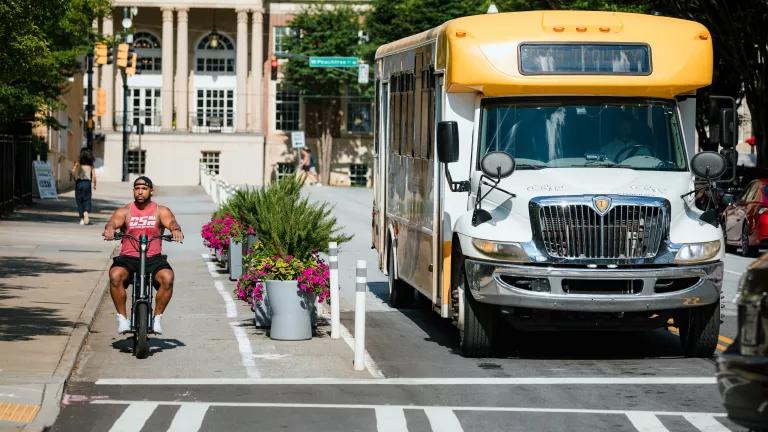

In states like California, Colorado, Georgia, and Michigan, transportation is typically the largest household expense after housing. In these states, families spend $16,000 to $18,000 annually on car payments, fuel, maintenance, and insurance, which represents anywhere from 17 to 23 percent of median household incomes. As gas prices—and prices for vehicle purchase, maintenance, and insurance—continue to rise, families are forced to devote more of their income to getting where they need to go. Most families have no choice but to absorb those costs, because in many places, driving is the only practical way to get to work, school, or the doctor. It doesn’t have to be this way. State leaders can change that by giving families more choices: reliable transit, safe routes for walking and biking, and electric vehicles (EVs) that cost less to fuel and maintain. Clean transportation belongs at the center of a governor’s affordability agenda because it lowers household costs while improving access, air quality, and economic resilience.
LEARN MORE


For example, if state leaders enact policies that make it more possible for families with two gas sedans to switch one of those vehicles for electric, this would save families anywhere from $600 to $1,200 annually, or $7,000 to $15,100 over the average life of a vehicle. State leaders could also invest more in expanding access to transit, biking, walking, and bike- or car-share opportunities. If a two-car household could drop to a single EV by shifting some trips to other travel options, they would generate even larger savings: $4,000 to $5,200 annually, or $50,300 to $66,100 over the average life of the vehicle.
On top of direct household transportation costs, nearly all food and most consumer goods are transported via truck, most of which still run on diesel. Moving away from diesel—which is not only vulnerable to price spikes but also disproportionately contributes to the toxic air pollution that drives up our public health costs—must be a priority for protecting both our lungs and our pocketbooks.
New governors in California, Colorado, Georgia, and Michigan should take steps to modernize transportation funding systems to ensure that taxpayer dollars are spent on projects that deliver the most options and greatest benefits for state residents, increase EV charging deployment to make the choice to switch to electric easier for families, and mitigate the cost of volatile diesel prices by electrifying freight transport, among other policies.
READ THE FULL FACT SHEETS
Related Resources
NRDC Inflation Reduction Act Ad Campaign

Climate Change and State-Level Health Impacts
