
Congress Is Targeting the DOE’s Innovation Pipeline: U.S. Consumers Will Pay the Price
The House Energy and Water Development bill will cut what works.

Think about the energy-efficient windows in your living room, the LED lights in your kitchen, or the solar panels on your neighborhood school. These innovations didn’t happen by chance. They exist because of years of steady federal investment in the U.S. Department of Energy (DOE). So why is Congress cutting the very DOE programs that helped make these innovations and many others possible?
Just weeks after passing one of the most damaging anti-environmental bills in U.S. history, Congress is once again moving to undermine progress on clean energy, high-quality jobs, and American innovation. The House of Representatives’ fiscal year 2026 DOE budget proposal includes sweeping slashes to core clean energy offices: a proposed 47 percent reduction to the Office of Energy Efficiency and Renewable Energy (EERE); an elimination of funding for the Office of Clean Energy Demonstrations (OCED); and a revocation of Bipartisan Infrastructure Law funding from DOE programs that support hydrogen, battery recycling, energy improvements in public schools, and other topics. The House is enabling the president and the Energy secretary’s ongoing efforts to dismantle decades of U.S. clean energy milestones, and the consequences will be felt in every corner of our country.
Make no mistake: These cuts to the DOE will do nothing to lower energy costs. On the contrary, they will block the very innovations that help reduce energy bills and cut harmful air pollution. What the House funding proposal puts at stake is the future of our economy. Our global leadership, our national energy security, and the affordability of emerging energy solutions all depend on a strong, functioning DOE. Whether we choose to sustain progress or let it unravel will determine whether America leads or lags in the 21st-century global energy economy.
Protecting the innovation pipeline and U.S. progress
The DOE is the quiet engine behind America’s clean energy breakthroughs. The department’s success is made possible through a legacy of federal investment, smart public-private partnerships, and a robust innovation ecosystem that takes ideas from research to real-world solutions. The DOE’s clean energy portfolio is not a patchwork of isolated projects; it’s a pipeline that connects scientific discovery to large-scale deployment.
Without steady federal support, our country’s clean energy innovation pipeline begins to unravel. The bridge between basic science and commercial application erodes. Promising technologies stall, deployment programs shrink or vanish, and emerging industries lose momentum as workforce development and supply chain investment fall behind. In most cases, it’s not technical limitations that cause failure; it’s the unpredictability of congressional appropriations, the abrupt end of initiatives, significant staff losses, and the deliberate dismantling of essential institutional infrastructure. The consequences are real and immediate: higher utility bills, lost jobs, and the offshoring of clean energy manufacturing and innovation.
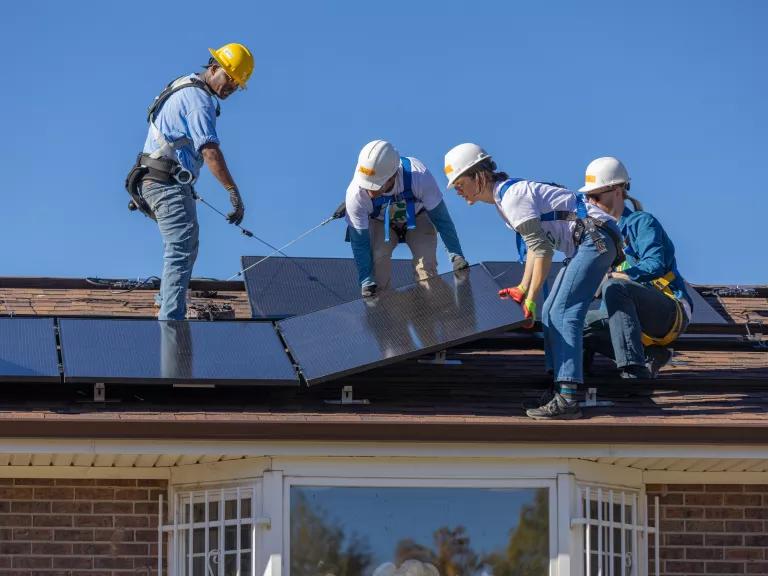
National Renewable Energy Laboratory and GRID Alternatives Colorado staff installing rooftop solar panels during a GRID Alternatives event at a home in Colorado
From breakthroughs to missed opportunities: How disinvestment and inaction cost Americans
The DOE played a vital role in advancing technologies such as high-efficiency windows, LED lighting, solar panels, and industrial upgrades. These successes underscore what is possible when federal investment helps scale innovation and how—when investments prematurely fade—they hinder momentum and limit the full range of benefits available to American workers, businesses, and communities.
High-efficiency windows offer a clear example. In the 1980s, researchers at the DOE’s Lawrence Berkeley National Laboratory developed low-E window coatings, now found in more than 80 percent of U.S. homes and 50 percent of commercial buildings. These advances, carried forward by the DOE’s Building Technologies Office through prototyping, validation, and the Energy Star program, help Americans save an estimated $10–$20 billion annually on their energy bills. That estimate reflects the share of energy savings attributed to high-efficiency windows within the broader $42 billion in annual savings from Energy Star–certified products in 2020.
High-efficiency windows are a success story for public sector innovation. However, the momentum plateaued in the mid-2010s after federal support for next-generation envelope technologies, such as dynamic glass and smart façades, declined. Without sustained federal investment, these promising technologies were left stranded between the lab and the market, and U.S. households missed out on further energy savings and resilience gains.
LED lighting followed a similar arc. A 60-watt equivalent LED cost $40–$50 in 2008. By 2020, the price had dropped to $3, largely due to the DOE’s coordinated support for solid-state lighting R&D, standards development, and early market-building tools, such as the L-Prize and Energy Star.
Within the DOE, Advanced Research Projects Agency-Energy (ARPA-E) catalyzed materials innovations, while EERE led cross-sector coordination and deployment programs that brought LEDs to scale. Federal stimulus funding under the American Recovery and Reinvestment Act also helped accelerate the adoption of these technologies in public buildings and pilot projects. It was a dramatic success in both cost reduction and adoption. Still, later efforts to expand access to underserved communities and support for domestic manufacturers slipped away when most of the supply chain shifted overseas.
Solar energy went further than the other examples; however, it still fell short of its potential. Launched in 2011, the DOE SunShot Initiative aimed to cut solar costs by 75 percent within a decade, and the DOE reached that goal three years ahead of schedule. Strategic federal investments in national lab research, photovoltaic efficiency, soft cost reductions, and grid integration helped bring utility-scale solar energy below 6 cents per kilowatt-hour, leading to the United States leading the world in cost and installation breakthroughs.
Solar deployment succeeded, but U.S. domestic manufacturing was unable to compete with subsidized producers abroad, resulting in shuttered or relocated U.S. operations offshore. Millions of families now benefit from low-cost solar energy, which is a significant win; however, U.S. solar manufacturing and supply chains remained dormant before the Inflation Reduction Act. While the act’s tax incentives for manufacturing drew billions of dollars in investments in solar energy, the premature elimination of these incentives threatens to leave the United States dependent on imports.
Lastly, the industrial sector is an example of the high cost of federal inconsistency. The DOE’s Industrial Training and Assessment Centers have helped more than 20,000 small and mid-size factories identify potential energy efficiency savings worth $130,000 per facility per year.
Through its Advanced Materials and Manufacturing Technologies Office, the DOE also supported technologies, such as combined heat and power, smart sensors, and low-carbon materials that reduce costs, boost productivity, and strengthen supply chains. But after an initial surge of investment in the early 2010s, many promising initiatives were defunded or discontinued. More recently, the DOE launched the Industrial Demonstrations Program to reduce emissions and support competitiveness in sectors such as steel and cement; however, budget rollbacks have led to widespread project cancellations while the recent reconciliation bill eliminated all funding for future projects, halting progress once again.
Congress funded the creation of offices like the DOE’s OCED and supported the establishment of the Grid Deployment Office and Office of Manufacturing and Energy Supply Chains to close persistent gaps between research and deployment, such as the missed opportunities highlighted in the examples above. However, today’s congressional majority has effectively gutted the original intent of those offices. The deeper issue is structural: These programs still lack durable authorizations or statutory protection. Without such guardrails, even high-performing offices like EERE and ARPA-E remain vulnerable to partisan whiplash. We’re amid a budget fight while also grappling with a structural design flaw that puts the entire pipeline at risk.
Protecting the clean energy ecosystem is not solely about protecting the DOE’s innovation offices. Programs like the Weatherization Assistance Program and the State Energy Program may not fund technology development directly, but they are essential to making the benefits of clean energy a reality. These programs help reduce energy burdens, improve comfort and safety in homes, and ensure that energy affordability and equity remain central in our energy future.
Debunking the “mature technology” myth
To make their case for the House bill’s proposed cuts to EERE, some lawmakers argue that solar and wind energy no longer need research, development, demonstration and deployment (RDD&D) federal support because they’re “mature.” That claim ignores the role of public investment in overcoming real-world barriers and masks deeper ideological opposition to renewables.
Yes, the cost of utility-scale solar has dropped by more than 90 percent since 2009, and onshore wind by more than 70 percent, thanks in large part to sustained support from the DOE. But affordability alone doesn’t ensure that clean energy reaches all communities, integrates seamlessly with the grid, or builds a resilient domestic supply chain.
While utility-scale solar has expanded rapidly, rooftop systems remain out of reach for many low-income and rural households. The DOE’s Solar Energy Technologies Office (SETO) plays a key role in closing this gap by supporting innovations like agrivoltaics, which pair solar generation with active agriculture to diversify farm income, increase crop yields, and improve livestock welfare. SETO also advances domestic solar manufacturing to reduce import dependence and build stronger U.S. supply chains through RDD&D activities. These efforts help ensure solar innovation benefits more U.S. communities.
The Wind Energy Technologies Office (WETO) plays a similarly essential role in scaling wind power. WETO’s work on offshore wind, from port infrastructure to floating platforms and transmission planning, is laying the foundation for a new generation of projects. Meanwhile, onshore wind faces critical challenges related to material, land use, and recycling hurdles that require continued innovation. Without sustained federal investment, we risk importing the building blocks of our clean energy economy instead of building them here at home.
Grid integration obstacles are also growing. As solar and wind energy make up a larger share of electricity generation, our power system must be able to manage variability and respond to extreme weather conditions. During recent heat waves in California and Texas, DOE-supported tools—including advanced inverters, forecasting software, and distributed energy coordination—helped keep the grid stable and prevent blackouts. But scaling today’s grid tools won’t be enough. Investments in new technologies are necessary to overcome emerging barriers in interconnection, reliability, energy storage, and system control. Without grid innovations, the risk of power outages and grid failures will rise, threatening public safety and economic stability.
Supporting federal RDD&D for “mature” technologies isn’t unusual. Defense and agriculture technologies receive ongoing federal investment because they serve enduring public purposes. Clean energy is no different. Market success doesn’t guarantee broad public benefit, but continued investment ensures that innovation drives forward American global leadership, benefiting the pocketbooks of everyday Americans.

Turbines at Block Island Wind Farm, off Block Island, Rhode Island
Congress must defend clean energy innovation programs
We must take a holistic view of the recent partisan attacks aimed at weakening the U.S. clean energy ecosystem. The majority’s reconciliation bill undermines clean energy tax credits, stifles project investment, and, according to Princeton University’s Zero-carbon Energy systems Research and Optimization Laboratory, the bill will raise U.S. household and business energy expenditures by $28 billion annually in 2030 and more than $50 billion in 2035.
Meanwhile, the Trump administration is actively diverting federal funds away from the DOE’s wind, solar, buildings, electric vehicle, and local government energy programs, despite congressionally approved spending levels. These actions, compounded by both enacted and looming rescission packages, represent a deliberate targeting of proven programs and initiatives.
Together, the actions reflect a familiar political cycle that seeks to dismantle the federal clean energy pipeline, only to have Congress rebuild it. That instability slows U.S. progress, increases costs, wastes public resources, and undercuts long-term trust in the federal government. The difficult lesson is that restoring funding alone will not repair the damage here—rebuilding requires a fundamentally different approach to public investment. Clean energy innovation cannot be treated as a temporary add-on. It must be protected, institutionalized, resilient to political cycles, and tied to the benefit of workers and communities.
Congress still has time to prevent the harmful cuts to the DOE and safeguard the programs that drive American innovation. What’s at stake goes beyond climate progress—it’s whether we build an energy system that serves communities and strengthens our energy independence. Congress must maintain the DOE’s clean energy pipeline to ensure the well-being of our economy, national security, and future generations.
Related Blogs

We Can't Afford to Slow Down on Climate Action
The Time Is Now to Stand with Clean Energy Workers
